Understanding the Magic Behind AI Image Generation
If you've ever typed a prompt into an AI image generator and watched in amazement as your words transformed into a detailed image, you've witnessed one of the most revolutionary technologies in creative content production. But what's actually happening behind the scenes? For content creators looking to leverage AI tools effectively, understanding the fundamentals of diffusion models isn't just academic curiosity—it's practical knowledge that can dramatically improve your results.
Diffusion models represent the current state-of-the-art in AI image generation, powering platforms like Lyndium, Midjourney, Stable Diffusion, and DALL-E. Unlike earlier AI approaches, diffusion models create images through a process that mimics how an artist might gradually refine a sketch, starting from pure noise and progressively adding detail until a coherent image emerges.
The Two-Phase Process: Training and Generation
To truly grasp how diffusion models work, you need to understand that they operate in two distinct phases: the training phase (which happens once, by the model creators) and the generation phase (which happens every time you create an image).
Phase 1: Training the Model
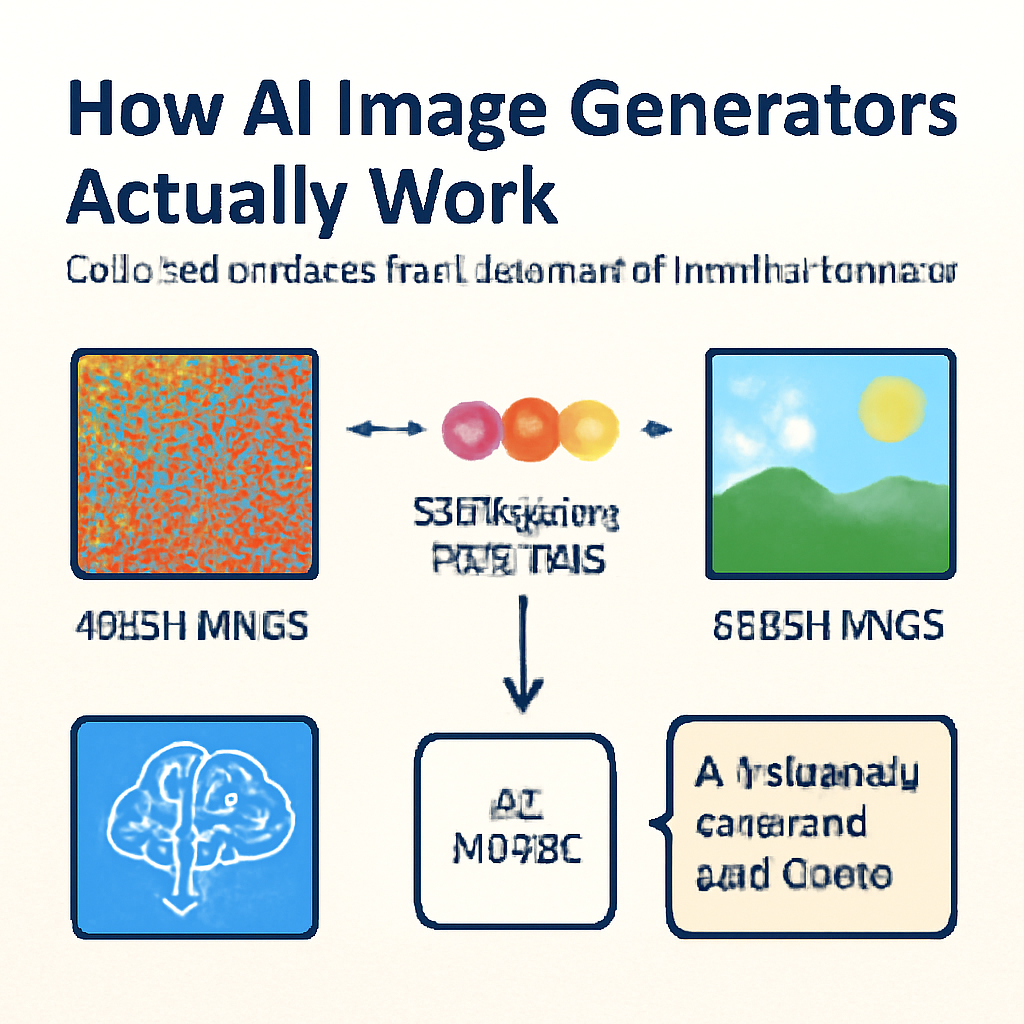
During training, the AI learns the relationship between images and noise through a process called the "forward diffusion process." Imagine taking millions of photographs and gradually adding random static to each one, step by step, until they become completely unrecognizable noise. The model learns to recognize patterns at every stage of this degradation process.
Simultaneously, the model learns text associations. Each training image is paired with descriptive text (captions, tags, or descriptions), teaching the AI to understand what "a sunset over mountains" or "a futuristic cityscape" looks like in visual terms. This creates a vast knowledge base connecting language concepts to visual patterns.
Phase 2: Generating Your Image
When you enter a prompt, the generation process reverses what happened during training. The model starts with pure random noise—essentially television static—and gradually removes that noise in a controlled way, guided by your text prompt. This is called the "reverse diffusion process" or "denoising."
Think of it like a sculptor removing marble to reveal a statue, except the AI is removing noise to reveal your image. At each step, the model predicts what the image should look like with slightly less noise, making hundreds of tiny refinements until a clear, detailed image emerges that matches your description.
The Technical Components Content Creators Should Know
The U-Net Architecture
At the heart of most diffusion models is a neural network architecture called U-Net. This component examines the noisy image at each step and predicts what noise should be removed next. For creators, understanding this helps explain why AI-generated images sometimes have certain characteristics—the U-Net has learned specific visual patterns and relationships from its training data.
Text Encoders and CLIP
Your text prompt doesn't go directly to the image generator. First, it passes through a text encoder (often using technology called CLIP) that converts your words into a mathematical representation the model understands. This is why prompt engineering matters—certain phrasings align better with how the model has learned to associate text with images.
For content creators, this explains why being specific and descriptive in your prompts yields better results. The text encoder needs clear semantic information to guide the denoising process effectively.
Latent Space vs. Pixel Space
Modern diffusion models like those used in Lyndium often work in "latent space" rather than directly on pixels. This means they operate on compressed, abstract representations of images, making the process faster and more efficient. A separate component called a VAE (Variational Autoencoder) translates between this latent space and the actual pixels you see.
This technical detail matters for creators because it affects generation speed and image quality. Latent diffusion models can produce high-resolution images much faster than pixel-space models, which is why modern AI image generation has become practical for content workflows.
Why Diffusion Models Produce Better Results
Compared to earlier AI image generation methods like GANs (Generative Adversarial Networks), diffusion models offer several advantages that directly benefit content creators:
- Higher image quality and diversity: The gradual refinement process allows for more detailed and varied outputs
- Better prompt adherence: The iterative nature means the model can maintain alignment with your text throughout generation
- More stable training: This translates to more predictable and reliable results for end users
- Flexibility in generation: The step-by-step process allows for techniques like image-to-image transformation and inpainting
Practical Implications for Content Creators
Understanding Sampling Steps
When using AI image generators, you'll often see a setting for "steps" or "sampling steps." This refers to how many denoising iterations the model performs. More steps generally mean higher quality but longer generation time. Most platforms default to a sweet spot (typically 20-50 steps) that balances quality and speed.
For content creators on deadlines, understanding this trade-off helps you choose appropriate settings. Quick concept sketches might need only 20 steps, while final marketing materials might warrant 50+ steps for maximum detail.
Why Negative Prompts Work
Many AI image platforms offer "negative prompts"—descriptions of what you don't want in your image. This works because the model is guided by mathematical vectors in its latent space. By specifying negative elements, you're essentially telling the model to steer the denoising process away from certain patterns, giving you more control over the final output.
The Role of Seeds and Randomness
Every generation starts with a different random noise pattern, controlled by a "seed" number. Using the same seed with the same prompt produces the same image, while different seeds create variations. This is why you can generate multiple versions of a concept and why saving seed numbers helps you recreate successful results.
Advanced Concepts: ControlNet and Fine-Tuning
As you advance in your AI image creation journey, you'll encounter technologies built on top of base diffusion models. ControlNet, for example, adds spatial guidance to the diffusion process, letting you control composition, pose, or structure while the model handles style and details. This represents the next evolution in giving creators precise control over AI-generated content.
Fine-tuning and LoRA (Low-Rank Adaptation) models allow diffusion models to learn specific styles, characters, or subjects. Platforms like Lyndium may offer access to specialized models trained on particular aesthetics, giving content creators ready-made style options without needing to engineer complex prompts.
The Future of Diffusion Models for Creators
Understanding diffusion models helps you anticipate where AI image generation is heading. Current research focuses on:
- Faster generation: New techniques are reducing the steps needed without sacrificing quality
- Better prompt understanding: Improved text encoders will make AI more intuitive to direct
- Consistent character generation: Solving the challenge of creating the same subject across multiple images
- Video and 3D: Extending diffusion principles to temporal and spatial dimensions
For content creators, these advances mean AI tools will become increasingly integrated into professional workflows, not as replacements for creativity but as powerful collaborators that handle technical execution while you focus on vision and strategy.
Putting Knowledge into Practice
Understanding how diffusion models work transforms you from a passive user into an informed creator who can troubleshoot issues, optimize workflows, and push the boundaries of what's possible. When you know that the model is gradually refining noise based on learned patterns, you can better understand why certain prompts work, why generation sometimes fails, and how to adjust your approach for better results.
Platforms like Lyndium abstract away the technical complexity while giving you access to the creative power of diffusion models. But knowing what's happening under the hood—that iterative denoising process transforming random static into your vision—helps you work more effectively with these tools and anticipate their capabilities and limitations.
As AI image generation continues to evolve, the fundamental principle of diffusion models—gradual refinement guided by learned patterns—will likely remain central to how machines help us create visual content. For content creators willing to understand the technology behind the magic, this knowledge becomes a competitive advantage in an increasingly AI-augmented creative landscape.
Frequently Asked Questions
Lyndium Team — AI Research & Product Team
The Lyndium Team builds AI-powered tools that help creators and businesses generate images, videos, websites, marketing content, and digital assets using the latest Artificial Intelligence technologies.